BuckPow
Measure. Observe. Optimize.
BuckPow enables engineers and researchers to measure, organize, benchmark, and analyze energy consumption through reproducible experiments. Instead of treating power measurements as isolated telemetry, BuckPow provides an end-to-end workflow for energy characterization and optimization.
| Layer | Stack |
|---|---|
| Backend | FastAPI + SQLAlchemy + Alembic |
| Frontend | HTMX + Tailwind CSS + Chart.js |
| Database | SQLite (default) / PostgreSQL / MySQL |
| Firmware | Arduino (ESP32, ESP8266 + INA219) |
| Deploy | Docker Compose or standalone |
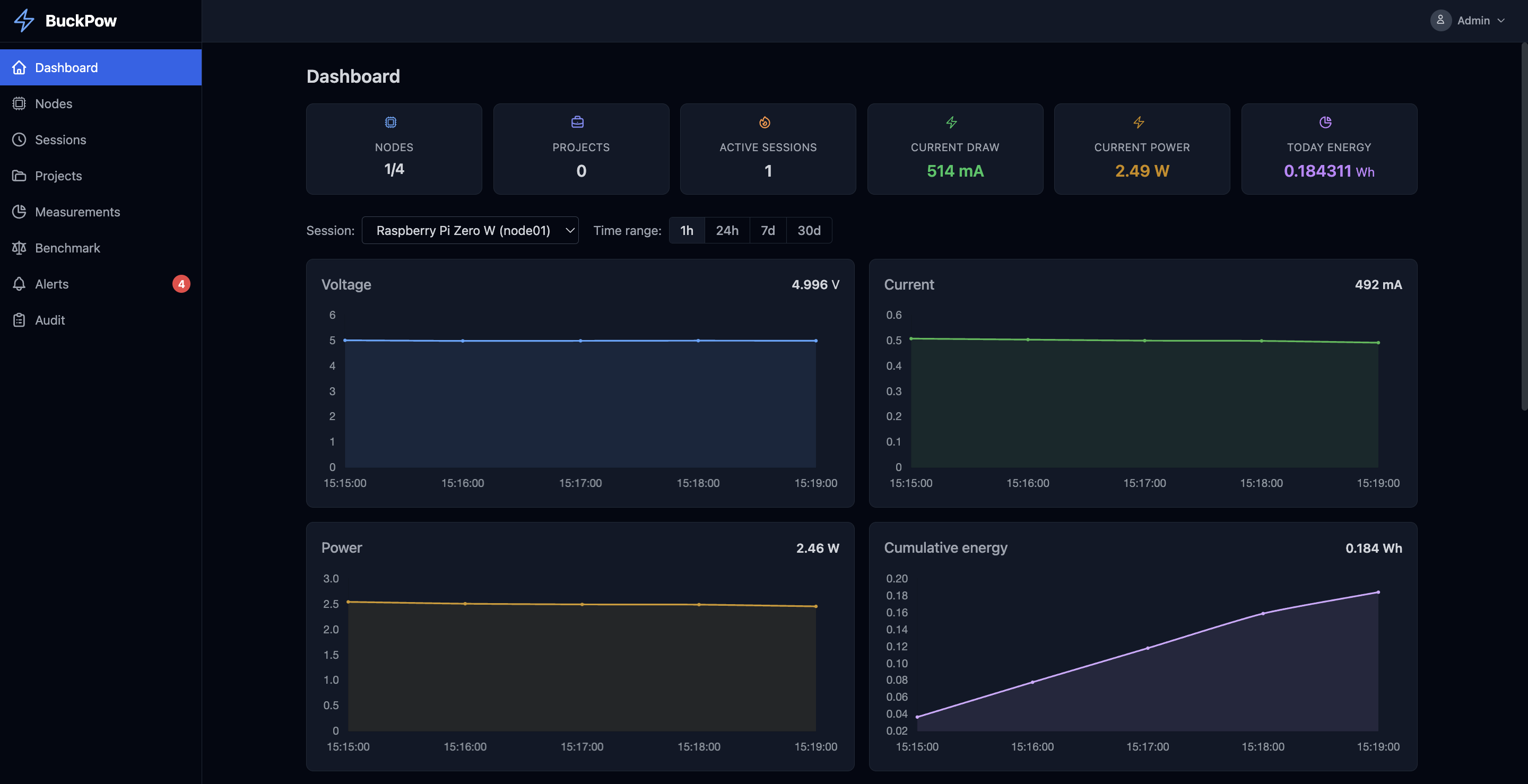
Screenshot
What is BuckPow
BuckPow is an open-source, self-hosted energy observability platform for low-power edge devices.
Unlike traditional IoT dashboards that focus on displaying live telemetry, BuckPow organizes measurements into reproducible engineering experiments. Every measurement belongs to a session, making it easy to compare hardware platforms, firmware versions, batteries, operating modes, workloads, and deployment scenarios.
BuckPow combines measurement nodes, embedded firmware, REST APIs, and a web-based dashboard into a complete workflow for collecting, visualizing, benchmarking, and analyzing energy consumption.
Whether you are validating an IoT prototype, optimizing battery life, benchmarking embedded Linux systems, profiling TinyML inference, evaluating solar-powered devices, or conducting academic research, BuckPow helps replace assumptions with reproducible measurements.
Why BuckPow
Traditional monitoring platforms answer:
"What is happening right now?"
BuckPow is designed to answer engineering questions such as:
- Which device consumes less power?
- Which firmware version is more energy efficient?
- Is my solar panel large enough for this system?
- How long will my battery last?
- How much energy does an OTA update consume?
- How much energy is required for one AI inference?
BuckPow helps replace assumptions with measurements.
Energy Observability
BuckPow is built around the idea that energy should be observable throughout the engineering lifecycle.
Measure → Observe → Compare → Benchmark → Optimize
Rather than collecting isolated measurements, BuckPow helps engineers understand how design decisions affect energy consumption and battery lifetime through reproducible experiments.
Core Capabilities
| Capability | Description |
|---|---|
| Real-time characterization | Voltage, current, power, and energy with live charts |
| Auto device registration | Unknown device_id values are registered automatically |
| Session recording | Organize measurements into timed experiments |
| Energy benchmarking | Compare 2-3 sessions side-by-side |
| Alert engine | Configurable thresholds per device (high power, high current, low voltage) |
| Data export | CSV and Excel with date range filtering |
| API key auth | Per-device API keys with masked display |
| Project organization | Group devices and sessions by project |
| Dark theme | System/light/dark toggle with persistence |
| Docker deployment | PostgreSQL + Nginx production stack |
Architecture
flowchart LR
    subgraph Edge Devices
        ESP["ESP32 / ESP8266"]
        PI["Raspberry Pi"]
        OTHER["Future Agents"]
    end

    subgraph BuckPow Platform
        API["BuckPow API"]
        DB[("Time-Series Measurements")]
        SESSION["Experiment Sessions"]
    end

    subgraph Energy Observability
        DASH["Observability Dashboard"]
        BENCH["Energy Benchmarking"]
        ALERT["Alert Engine"]
        EXPORT["CSV / XLSX Export"]
    end

    ESP --> API
    PI --> API
    OTHER --> API

    API --> DB
    DB --> SESSION

    SESSION --> BENCH
    SESSION --> DASH

    DB --> ALERT
    DB --> EXPORT
Measurement nodes collect readings from edge devices and send them to the BuckPow API. The API stores time-series measurements, manages experiment sessions and benchmarks, and serves an observability dashboard for visualization and analysis.
Supported Hardware
Measurement Nodes
| Current | Planned |
|---|---|
| ESP32 | Raspberry Pi Agent |
| ESP8266 | Linux Agent |
Supported Sensors
| Current | Planned |
|---|---|
| INA219 | INA226 |
| PZEM-004T | |
| MQTT devices | |
| Additional DC power sensors |
Quick Start
BuckPow starts on port 8000. Default admin: admin@example.com / password.
Environment Variables
| Variable | Default | Description |
|---|---|---|
APP_ENV |
development |
development or production |
JWT_SECRET |
buckpow-dev-key-... |
JWT signing key (required in production) |
APP_HOST |
0.0.0.0 |
Server bind address |
APP_PORT |
8000 |
Server port |
DATABASE_URL |
sqlite:///instance/buckpow.db |
Database connection string |
ADMIN_EMAIL |
(empty) | Auto-create admin on first run |
ADMIN_PASSWORD |
(empty) | Admin password |
DEVICE_ONLINE_TIMEOUT |
30 |
Seconds before marking device offline |
DEFAULT_SAMPLING_INTERVAL |
1 |
Default interval in seconds |
LOG_LEVEL |
info |
Python logging level |
DISABLE_API_DOCS |
false |
Disable /docs and /redoc |
Dashboard Pages
| Page | Description |
|---|---|
| Dashboard | Real-time charts and summary cards |
| Nodes | Node management and API keys |
| Sessions | Experiment session management |
| Measurements | Paginated readings with date filter |
| Projects | Project organization |
| Benchmark | Session comparison |
| Alerts | Alert management and resolution |
| Settings | Thresholds, theme, timestamps |
Developer API
BuckPow exposes a RESTful developer API under /api/v1/ for device integration, data export, and automation.
curl -X POST http://localhost:8000/api/v1/measurements \
  -H 'Content-Type: application/json' \
  -H 'Authorization: Bearer <api_key>' \
  -d '{
    "device_id": "esp32-01",
    "bus_voltage": 5.12,
    "shunt_voltage": 82,
    "current": 241,
    "power": 1234
  }'
See the API Reference for the full endpoint list.
Next Steps
-
Quick Start ---
Get BuckPow running in 5 minutes.
-
User Guide ---
End-user documentation for the dashboard, nodes, sessions, and more.
-
Developer Guide ---
Architecture, API, database, frontend, backend, and firmware internals.
-
Blog ---
Design decisions, comparisons, and case studies.
License
MIT License. See GitHub Repository for details.